
Gears
Why split ring gears are trial-assembled in our shop
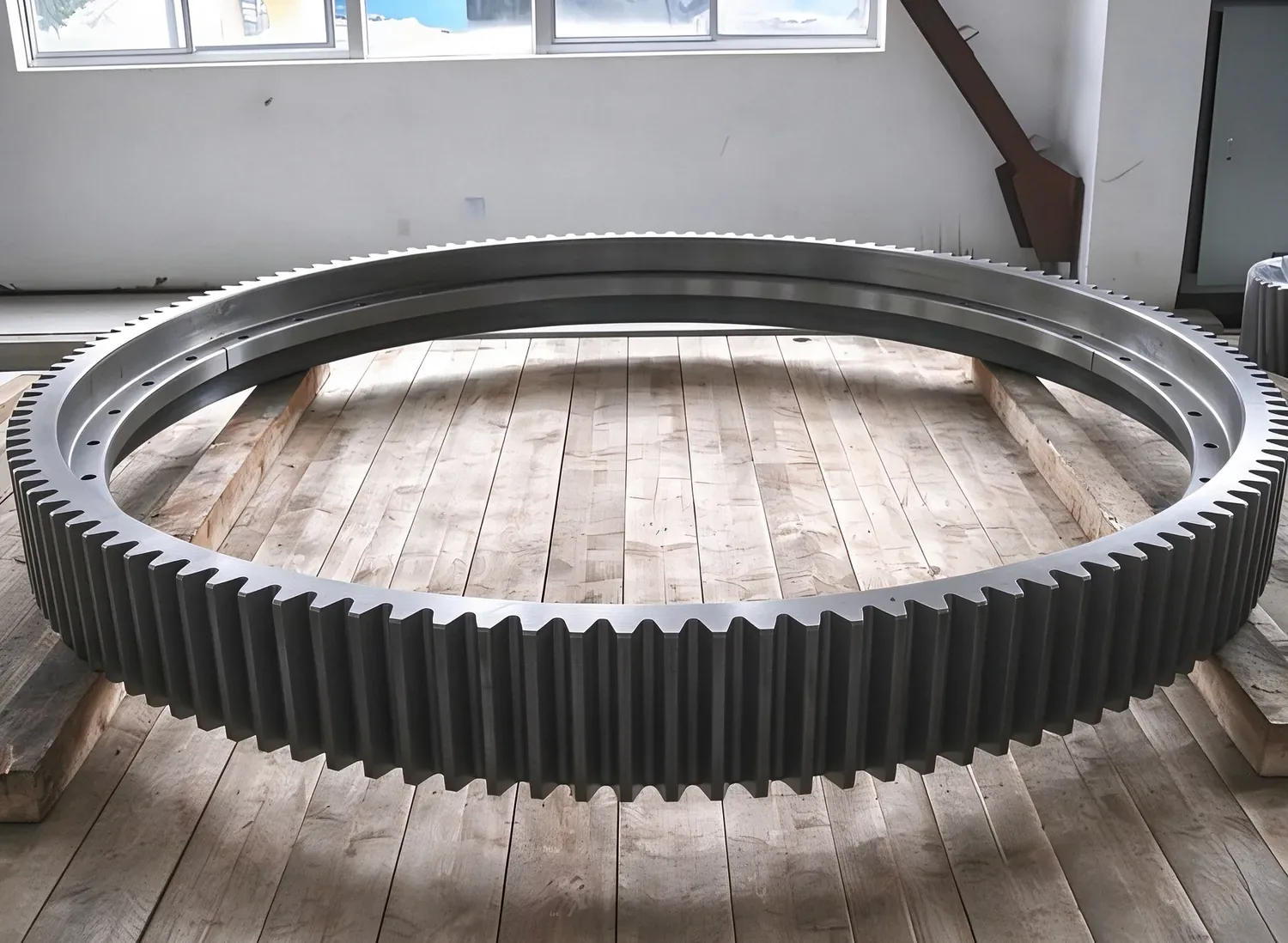
A ring gear larger than the transport limit has to be made in halves. Splitting it is not the hard part; the hard part is that it still has to be one ring after bolting. So we trial-assemble it before it ships.
Why split at all
When the diameter exceeds what a truck or crane can handle, the ring is made in two or four segments. The joint face then becomes a datum: each half is machined on its own and has to line up like a single ring when assembled.
A split ring also allows the gear to be fitted around a shaft that is already installed and cannot be removed. In that case the dowel holes and the joint faces decide whether the teeth line up once it is on the machine.
The order we follow
Blank, rough turning, stress relief, finish turning, drilling and reaming the joint faces, trial assembly, hobbing or shaping, tooth hardening, final inspection, packing.
- 01
Blank and rough turning
Leave stock, and let some of the casting or forging stress go before finishing starts.
- 02
Stress relief
Between roughing and finishing. Bore and faces then stay put through the remaining operations instead of moving after installation.
- 03
Joint faces
Both halves are drilled and reamed as a pair; dowel holes are machined from one datum so the halves locate and interchange.
- 04
Trial assembly
The halves are bolted together in shipping condition and checked for joint gap, roundness and pitch.
- 05
Cutting teeth
Teeth are cut after a successful trial fit, with pitch divided around the full ring — not cut separately per half.
What the trial fit checks
Trial assembly is not holding the two halves together and looking at them. It checks joint contact, dowel fit, radial and face runout, and accumulated pitch error.
- 01
Joint gap
Checked along the full length with a feeler gauge. A local high spot is scraped or re-fitted — never pressed flat with extra bolt torque.
- 02
Dowels and bolt holes
Matched pairs keep their numbers and ship in the same crate, so the halves cannot be mixed up on site.
- 03
Accumulated pitch
Measured after cutting around the full ring. The joint is where pitch error is most likely to exceed tolerance, and where a per-part inspection misses it.
On site
Align the match marks first, keep the joint faces out of the lifting load, and torque the bolts in a diagonal sequence in several passes.
If a joint does not close on site, stop and check the marks and the shims. Do not force it: torque will not close the gap; it just moves the error into the backlash, and the drive will still be noisy.
These notes describe processes we actually run. If you have a part to quote, send the drawing and we will answer with the process, the lead time and the tolerance we can hold.
Send drawing, get a quote