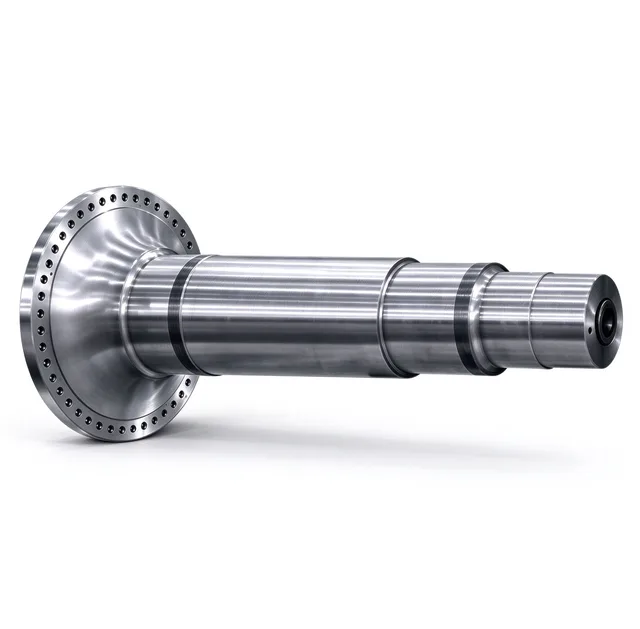
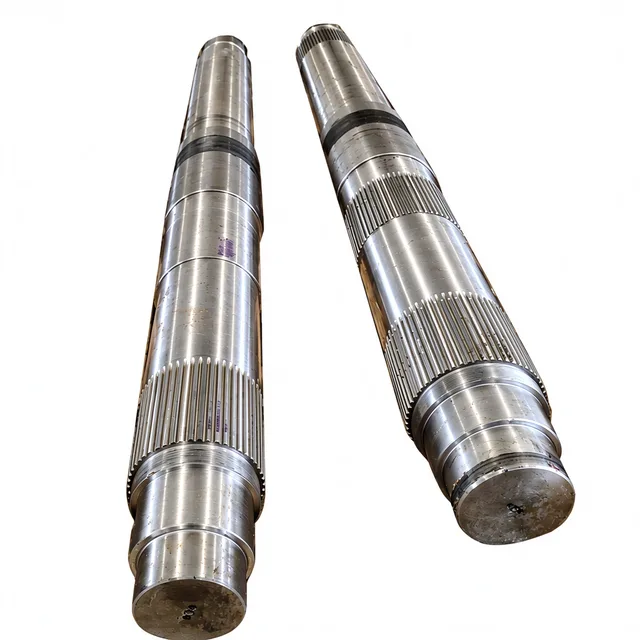
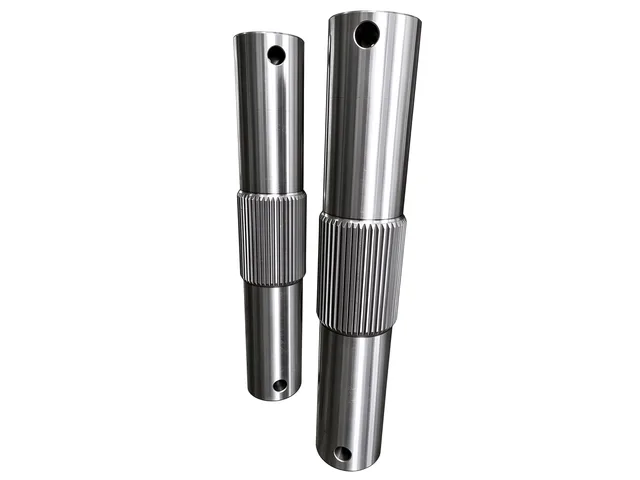
ShaftsTransmission shafts
Heavy-Duty Stepped Main Shaft with Square Mounting Flange
Heavy-duty stepped main shaft with an integral square mounting flange for vertical crushers and drives, providing bearing support, axial positioning, and torque transmission.
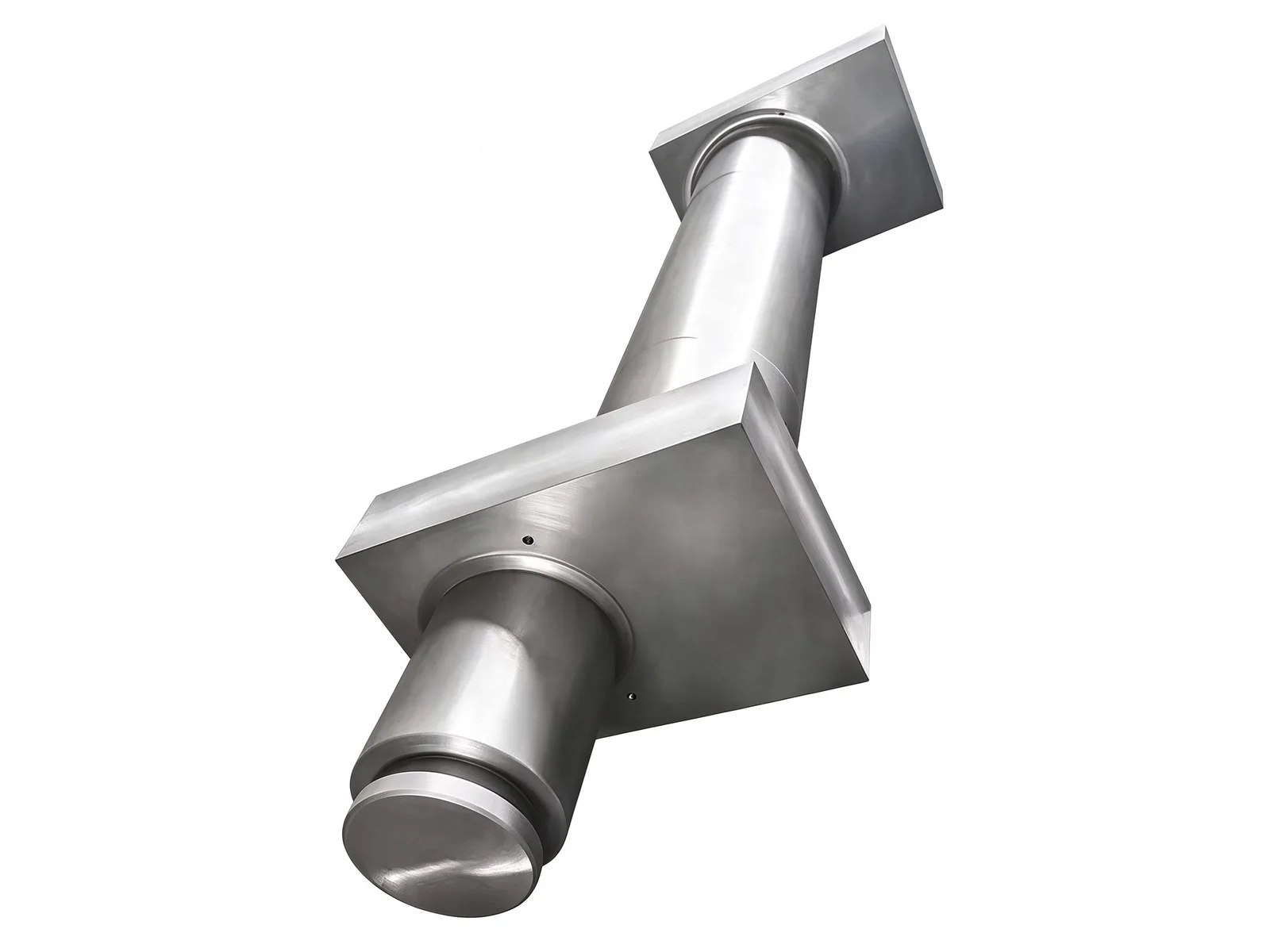
Integral Square Flange and Stepped Shaft
The shaft is produced as one body with a square mounting flange at mid-length. Bolt holes evenly distributed on the flange face secure the shaft to the equipment frame or housing, and the one-piece flange increases torsional rigidity and resistance to alternating torque and impact.
The body above and below the flange is stepped with multiple locating shoulders. These journals carry bearings, gears, spacers, and locknuts and provide radial support and axial positioning. The two ends are usually different in diameter: the larger end acts as the working output and the smaller end as the power input.
Machining and Heat Treatment
The shaft is integrally forged from alloy structural steel such as 42CrMo or 40CrNiMo, then quenched and tempered to balance strength and toughness. Key mating surfaces are hardened for wear resistance under heavy and impact loading.
Mating surfaces are precision machined, and center holes at both ends serve as datums for turning and grinding and can also be used for axial locking or lifting. For shafts in this class, our machining capability reaches a maximum length of 10,000 mm including clamping, a maximum diameter of Ø1,500 mm, and a maximum single-piece weight of 8 t; journal tolerances can be held to h6 / IT7, surface roughness to Ra 0.8, and radial runout to within 0.02 mm.
Heavy-Duty Service Conditions
The design is intended for vertical transmission points that carry rotating support, working load, and torque under strong impact. It is commonly used in cone crushers, vertical compound crushers, heavy vertical reducers, and vertical mixing equipment.
Suitable working conditions include repeated heavy loads, alternating torque, and shock loading where flange rigidity and journal alignment are important. Hardened mating surfaces and controlled fits help maintain bearing and gear seating in these duties.
Quality Control and Customization
Dimensions, flange mounting pattern, overall length, and journal positions are confirmed against the drawing or a measured sample before machining. Fits, runout, and surface finish are checked to the drawing, and material and heat-treatment records can be kept with the part.
Custom options include shaft diameter and length, flange size and bolt-hole layout, journal fits, keyways, splines, threads, end-face flange holes, material selection, and heat-treatment condition. Typical lead time for custom shafts is 8–12 weeks.
Specifications
- Material
- 42CrMo / 40CrNiMo
- Heat treatment
- Quench and temper; key mating surfaces hardened
- Manufacturing
- Integral forging
Common questions
- Can you machine this part to my drawing?
- Yes. Every part is quoted from the drawing. Send a PDF, DWG, DXF, STEP or IGES file with the material, quantity and any inspection requirements, and we reply within one working day.
- How are the material and heat treatment decided?
- They follow your drawing. The specification table shows the range normally used for this part type; the final material and heat treatment are confirmed with the quotation.
- What lead time and inspection come with the part?
- Lead time is set in the quotation and depends on material, size, quantity and inspection scope. Material verification, in-process checks and final inspection records are archived with the part, and any extra certification is agreed before production.
- How is the part packed for export?
- Export parts are rust-proofed and packed for the transport method and destination confirmed in the quotation, with lifting points and markings agreed before dispatch.
Every part is quoted from the drawing itself, not from a size band. Send it over and we answer with the process, the lead time and the tolerance we can hold.
Quote this part