Shafts & RollersRolls
Spiral Groove Crane Drum Assembly
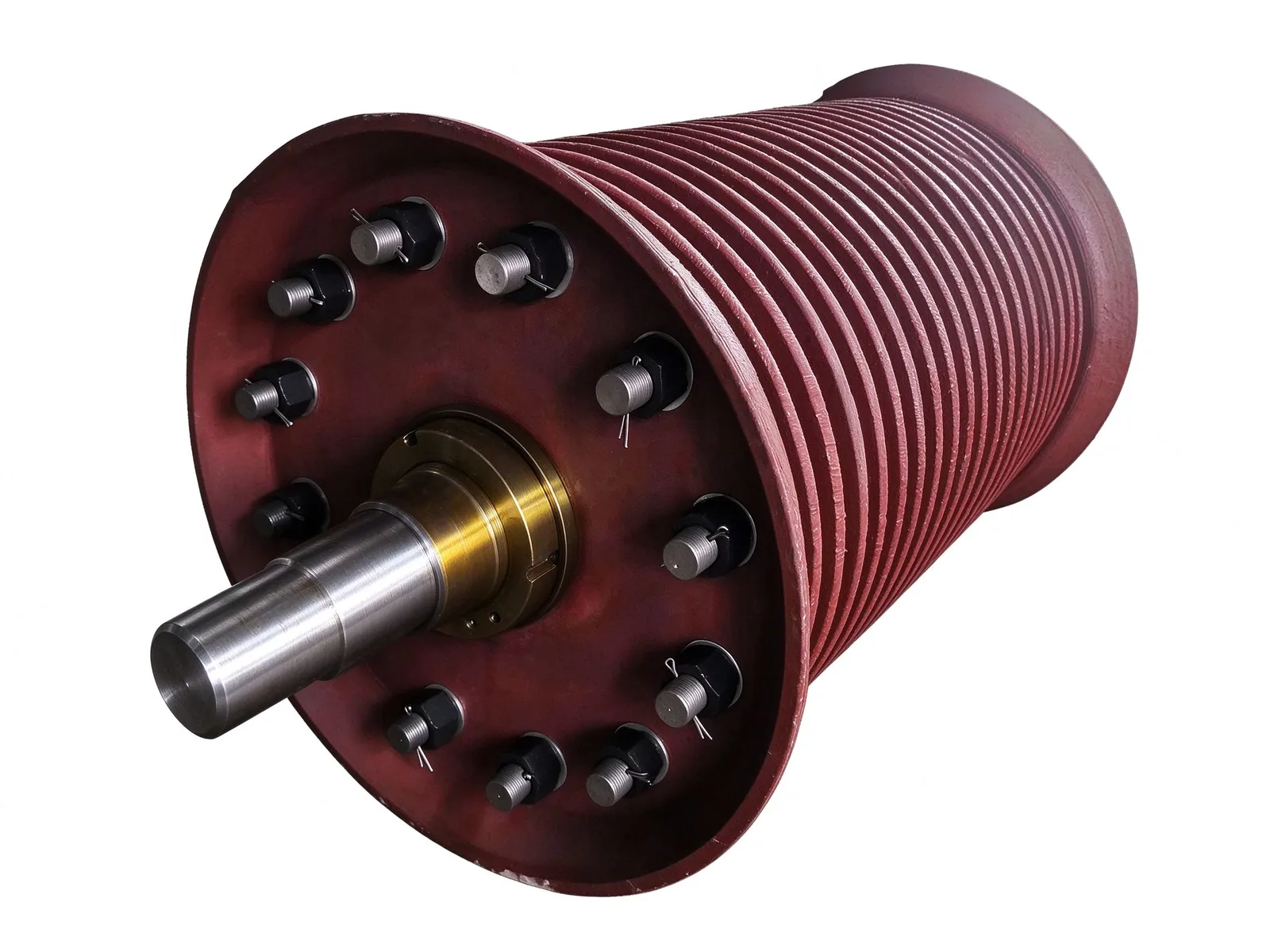
Welded steel drum body with a forged shaft, joined by a bolted end flange. Continuous spiral grooves spool the rope evenly for cranes, winches and mine hoists.
Groove turning and drum machining
A continuous, evenly pitched spiral groove is turned along the full length of the drum body, with raised rims at both ends acting as rope guards. Groove pitch is matched to the rope diameter so the wire rope spools in even layers without crossing, stacking or pinching.
Turning, boring and facing are done on CNC equipment sized for large rotary parts: up to Ø1 500 mm in diameter and 10 000 mm in working length including clamping.
Welded body, forged shaft, bolted joint
The barrel is rolled and welded from heavy steel plate, while the main shaft is machined from forged alloy structural steel. A ring of high-strength bolts on the end flange clamps the drum head to the shaft, so body and shaft turn as one unit and transmit torque together.
Shaft journals are machined to h6 / IT7 with radial runout held within 0.02 mm; keyways, splines, threaded ends and flange holes are cut to drawing.
Heavy-load service and quality control
This structure suits lifting and hauling duty on bridge and gantry cranes, construction winches, mine hoists, port handling equipment and shield machine traction systems, where loads are heavy and shocks reverse repeatedly.
Before painting, each drum is checked for groove profile, flange face, journal dimensions and runout; the finished assembly is then coated against rust for storage and transport. Outside diameter, groove pitch, flange bolt pattern and shaft end can be made to drawing.
Specifications
- Max. working length incl. clamping
- 10 000 mm
- Max. diameter
- Ø1 500 mm
- Shaft journal tolerance
- h6 / IT7
- Radial runout
- ≤0.02 mm
- Typical lead time
- 60 days
Common questions
- Can you machine this part to my drawing?
- Yes. Every part is quoted from the drawing. Send a PDF, DWG, DXF, STEP or IGES file with the material, quantity and any inspection requirements, and we reply within one working day.
- How are the material and heat treatment decided?
- They follow your drawing. The specification table shows the range normally used for this part type; the final material and heat treatment are confirmed with the quotation.
- What lead time and inspection come with the part?
- Lead time is set in the quotation and depends on material, size, quantity and inspection scope. Material verification, in-process checks and final inspection records are archived with the part, and any extra certification is agreed before production.
- How is the part packed for export?
- Export parts are rust-proofed and packed for the transport method and destination confirmed in the quotation, with lifting points and markings agreed before dispatch.
Every part is quoted from the drawing itself, not from a size band. Send it over and we answer with the process, the lead time and the tolerance we can hold.
Quote this part