Bearings & Machined PartsCouplings
Heavy-Duty Cardan Joint Fork
A one-piece forged fork for heavy-duty cardan shafts: two coaxial machined journals carry the bearings, and the U-shaped opening takes the cross journal and mating fork to form the joint.
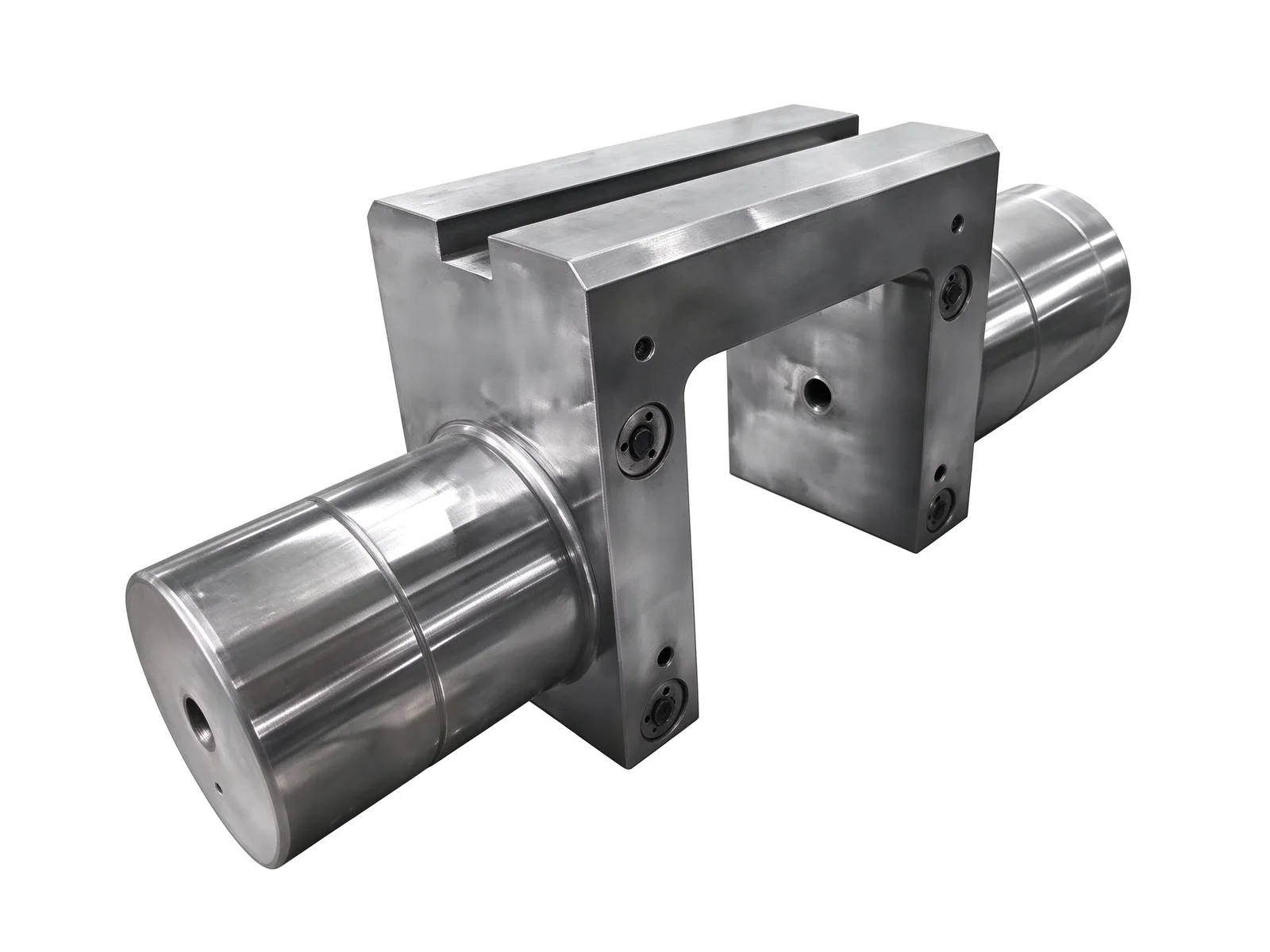
One-piece forged body with coaxial journals
The fork is machined from a single forged blank. Two coaxial cylindrical journals at the ends carry the bearings, while the U-shaped opening between the arms accepts the cross journal, the needle bearings and the mating fork to form the cardan joint. Because the body is one piece rather than welded, the two journals stay on a common axis after machining and the fork faces do not shift with weld distortion.
Machining of journals, fork opening and side holes
The journals are turned and ground to fit the bearing inner rings, the fork opening faces are milled, and the bolt holes and grease passages in the arms are drilled in the same set-up, so bearing covers and seals seat without on-site fitting. The grease holes feed lubricant through to the cross journal bearings.
Rolling-mill and press main drives
Used in the main drive trains of hot strip mills, plate mills and section mills, and on the drive shafts of heavy forging presses and mine hoists. The joint transmits high torque while the two shaft axes run at an angle, and compensates for installation offset and for deflection and axial float under load. Grease nipples and oil holes on the arms allow relubrication during maintenance intervals.
Made to drawing
Fork outline dimensions, journal diameter, bearing bore fit, bolt hole pattern and steel grade (42CrMo or 35CrMo) are confirmed against the customer's drawing or sample; the quotation is prepared after checking nominal torque and working tilt angle. Tell us the mating universal joint model and the fork is machined to its interface.
Specifications
- Material
- 42CrMo, 35CrMo
- Heat treatment
- Quenching and tempering
- Body construction
- One-piece forged fork
Common questions
- Can you machine this part to my drawing?
- Yes. Every part is quoted from the drawing. Send a PDF, DWG, DXF, STEP or IGES file with the material, quantity and any inspection requirements, and we reply within one working day.
- How are the material and heat treatment decided?
- They follow your drawing. The specification table shows the range normally used for this part type; the final material and heat treatment are confirmed with the quotation.
- What lead time and inspection come with the part?
- Lead time is set in the quotation and depends on material, size, quantity and inspection scope. Material verification, in-process checks and final inspection records are archived with the part, and any extra certification is agreed before production.
- How is the part packed for export?
- Export parts are rust-proofed and packed for the transport method and destination confirmed in the quotation, with lifting points and markings agreed before dispatch.
Every part is quoted from the drawing itself, not from a size band. Send it over and we answer with the process, the lead time and the tolerance we can hold.
Quote this part