Bearing Housings & Machined PartsCouplings
Heavy-Duty Disc Pack Flexible Coupling
A metal disc pack coupling that uses stacked annular discs and axial tie rods to connect drive shafts, absorb shock loads, and compensate radial, angular, and axial misalignment.
Stacked Disc Design and Misalignment Compensation
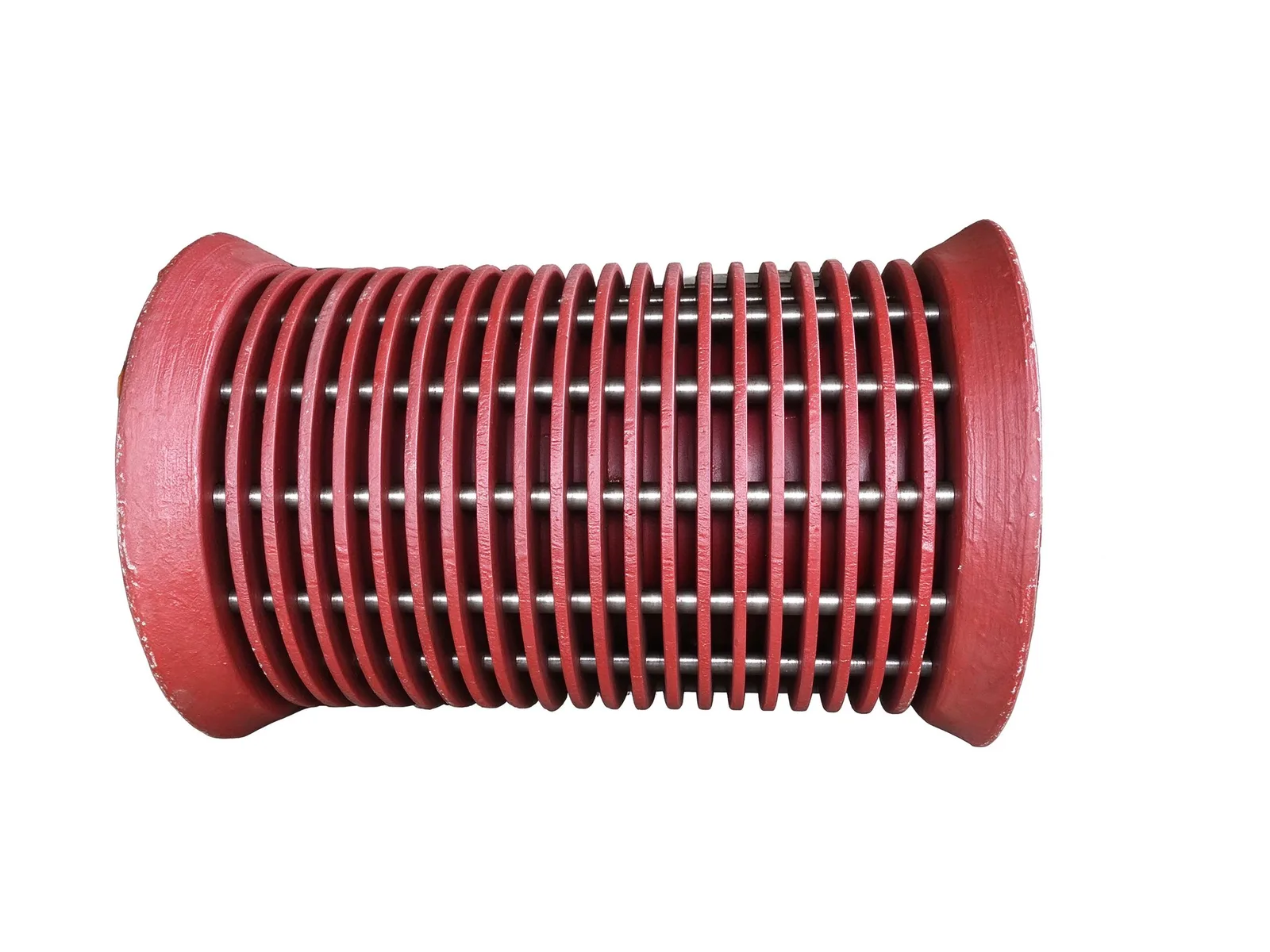
The coupling body is built from annular metal discs stacked axially, forming a waisted profile that is thicker in the middle and narrower toward both ends, with a gap left between adjacent discs. Equally spaced axial tie rods clamp the full stack against thickened end caps at each end.
During operation the slight elastic deformation of the metal discs compensates radial, angular, and axial installation and running offset between two shafts, and absorbs shock loads in the drive train so that less vibration reaches the shafting and bearings.
Heavy-Load Service and Harsh Environments
The discs and tie rods are made of high-strength structural steel and finished with an anti-rust coating, giving the assembly the strength to transmit high torque and to withstand repeated alternating shock loads.
Because the design contains no rubber or elastomer elements, the coupling is commonly used in high-temperature, dusty, and oily plant conditions. Worn discs can be replaced individually rather than scrapping the whole coupling, which keeps maintenance cost down.
Shaft Connection and Customization
Both thickened end caps act as mounting faces and can be joined to the drive shaft by keyed fit or flange bolting; the connection is rigid and reliable, and assembly and disassembly are straightforward.
Bore diameter, bore length, keyway or flange bolt pattern, disc count, and stack length are machined to the customer's drawing or sample. Couplings of this type are commonly used in crushers, vibrating screens, ball mills, and other mining and aggregate drives where heavy loads, strong impact, and installation offset are present.
Common questions
- Can you machine this part to my drawing?
- Yes. Every part is quoted from the drawing. Send a PDF, DWG, DXF, STEP or IGES file with the material, quantity and any inspection requirements, and we reply within one working day.
- How are the material and heat treatment decided?
- They follow your drawing. The specification table shows the range normally used for this part type; the final material and heat treatment are confirmed with the quotation.
- What lead time and inspection come with the part?
- Lead time is set in the quotation and depends on material, size, quantity and inspection scope. Material verification, in-process checks and final inspection records are archived with the part, and any extra certification is agreed before production.
- How is the part packed for export?
- Export parts are rust-proofed and packed for the transport method and destination confirmed in the quotation, with lifting points and markings agreed before dispatch.
Every part is quoted from the drawing itself, not from a size band. Send it over and we answer with the process, the lead time and the tolerance we can hold.
Quote this part