Gears & PinionsGear shafts
Heavy-Duty Helical Gear Shaft with Splined Output
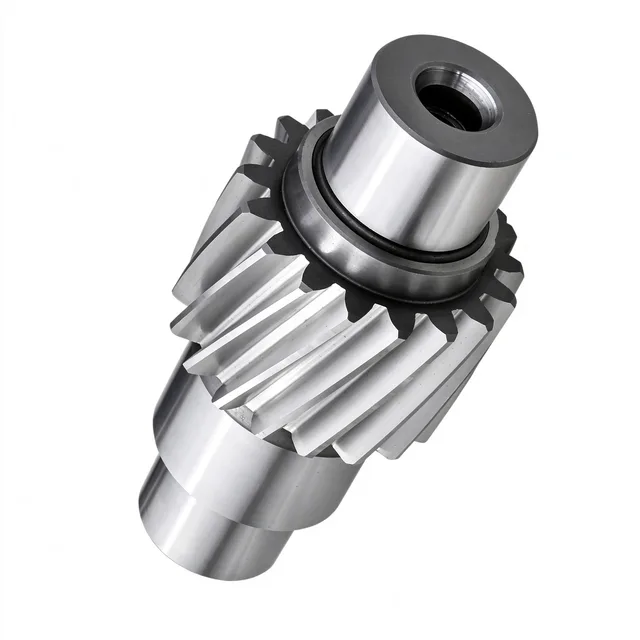
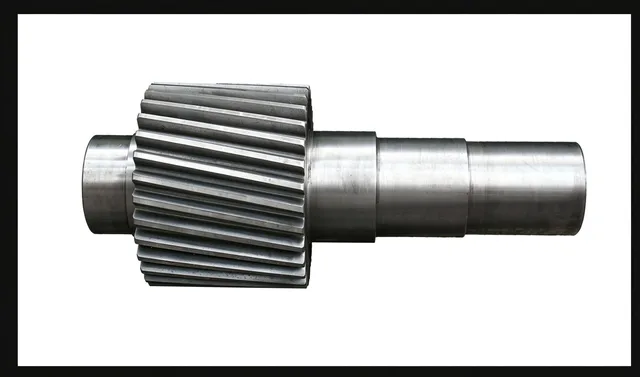
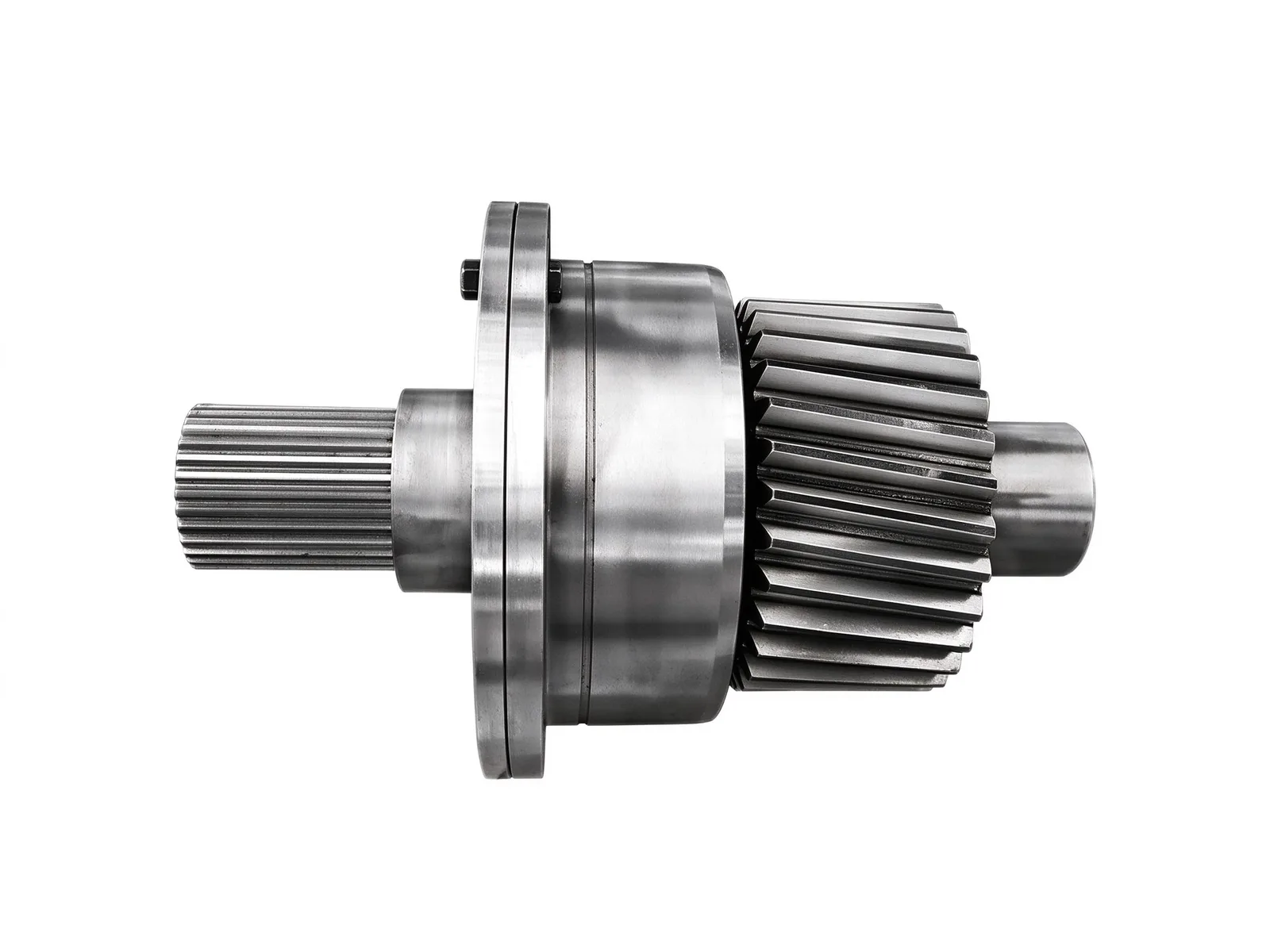
Integral forged helical gear shaft that combines a wide-face helical gear, a stiffened shaft body with a locating flange shoulder, and an involute splined output end for heavy-duty torque transmission.
Integral Shaft-and-Gear Construction
The gear and the shaft are forged and machined as a single body, so there is no assembled joint or fit clearance between them. This raises the torsional and impact resistance of the whole part and keeps the gear and shaft concentric under reversing loads.
The design is intended for the output side of heavy industrial drive trains, where a speed-reducing stage must deliver high torque to the driven machine through a splined connection.
Helical Gear Section
The gear end is a helical cylindrical gear with a wide face and a large module. The helical form gives a high contact ratio, which spreads load across several teeth at once and keeps running noise and vibration low while carrying high torque at low speed.
Teeth are hardened and precision ground, so the flank is a hard surface that resists wear and retains its profile over a long service life. Our gear cutting and grinding range covers outside diameters up to Ø10 000 mm and modules up to M60, with straight, helical, herringbone, and internal tooth forms available.
Shaft Body, Flange Shoulder, and Splined Output
The middle of the part is a large-diameter, thickened shaft body that raises bending stiffness and structural strength so the shaft can take very high torque and alternating impact loads. A locating flange shoulder on the shaft body axially positions the heavy-duty bearing, fixing the shaft in the housing and holding the gear mesh clearance.
The left end is an involute external spline. It mates with an internal spline on the load side, such as a coupling or a working machine shaft, and transmits the output torque across all teeth instead of a single key.
Quality Control and Customization
Tooth pitch, runout, and hardness are checked in house, and ultrasonic inspection can be performed on request. Blanks can be supplied as castings, forgings, or rolled rings, and heat treatment covers quenching and tempering as well as induction hardening of the tooth flanks, with a maximum hardening diameter of 10 000 mm. Typical lead time is within 90 days.
Spline size, tooth geometry, shaft length, journal diameters, and flange shoulder dimensions are all machined to drawing. Send the drawing or the mating part data and we will confirm the material grade, heat treatment, and bearing fit before quoting.
Specifications
- Max. outside diameter
- Ø10 000 mm
- Max. module
- M60
- Typical materials
- 45#, 42CrMo, ZG270-500
- Heat treatment
- Quenching and tempering, tooth flank induction hardening
- Typical lead time
- Within 90 days
Common questions
- Can you machine this part to my drawing?
- Yes. Every part is quoted from the drawing. Send a PDF, DWG, DXF, STEP or IGES file with the material, quantity and any inspection requirements, and we reply within one working day.
- How are the material and heat treatment decided?
- They follow your drawing. The specification table shows the range normally used for this part type; the final material and heat treatment are confirmed with the quotation.
- What lead time and inspection come with the part?
- Lead time is set in the quotation and depends on material, size, quantity and inspection scope. Material verification, in-process checks and final inspection records are archived with the part, and any extra certification is agreed before production.
- How is the part packed for export?
- Export parts are rust-proofed and packed for the transport method and destination confirmed in the quotation, with lifting points and markings agreed before dispatch.
Every part is quoted from the drawing itself, not from a size band. Send it over and we answer with the process, the lead time and the tolerance we can hold.
Quote this part