Other OEM PartsAssemblies
Multi-Rope Mine Hoist Head Sheave
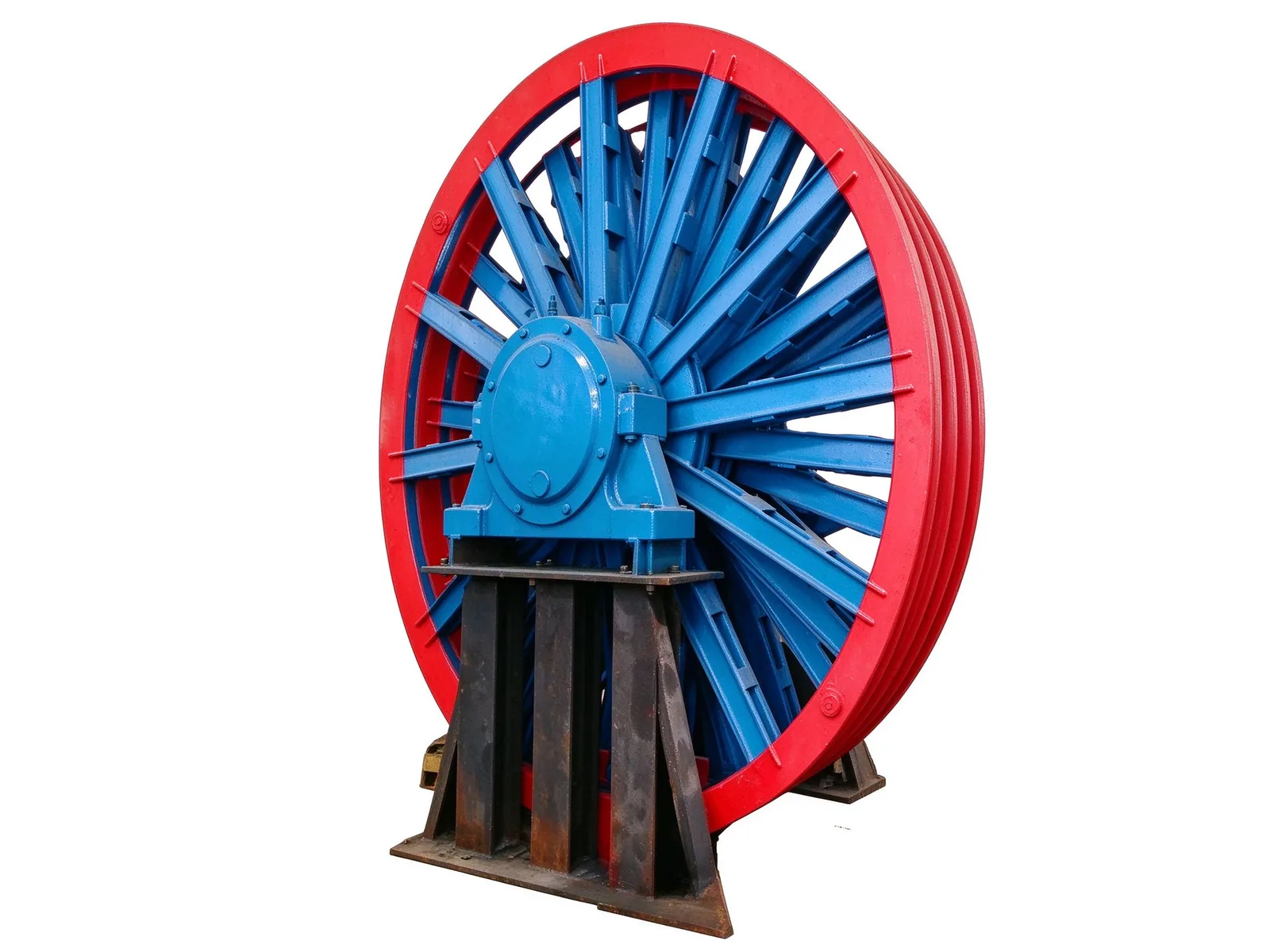
A multi-groove head sheave for mine shaft hoisting that carries and guides the hoist ropes. It is a rib-reinforced welded wheel running on a heavy-duty bearing hub with a bolted base frame.
Grooved Rim and Rope Guidance
The rim carries several parallel annular rope grooves, each matched to the hoist rope it runs on. The groove surface is hardened and finished with a red wear-resistant coating so that several ropes can be carried at the same time and led smoothly as the wheel turns.
The groove profile limits axial movement of the rope, which keeps ropes from jumping out of the groove or cross-twisting. This reduces rope wear and bending damage at the contact point and extends rope service life on multi-rope hoisting systems.
Wheel Body, Hub and Base
The wheel body is a radial rib-reinforced structure, supplied as a casting, weldment or welded ring, and finished with blue anti-rust paint. The rib layout keeps torsional stiffness and impact resistance while holding down the dead weight of a large-diameter wheel.
The center is a heavy-duty bearing housing with a built-in spherical roller bearing that takes the full rotating load and alternating impact load. The steel base frame below the hub is the mounting datum and fixes the sheave to the headframe or hoist platform.
Working Principle and Service Conditions
The sheave is installed at the top of a mine headframe, on the hoist house floor or on a sinking headframe. Working with the hoist drum, it changes the direction of the hoist rope and carries the weight of the cage, skip and payload, so it is a key load-bearing and guiding part of a shaft hoisting system.
It is commonly used in shaft hoisting systems at coal, metal and non-metal mines, matched with friction hoists and drum hoists, and is also suitable for heavy-duty guiding duty on large lifting equipment and aerial tramways.
Quality Control and Customization
Rim material and groove hardness, together with the welding procedure and inspection level of the wheel body, are confirmed against the quality documents for each order. Groove profile, rim runout and bearing fit are checked before assembly, and the finished unit is painted and marked for identification.
Rim diameter, number of rope grooves, matched rope diameter, rated load and bearing model are all made to the customer's drawing or nameplate data, so the sheave can be built to suit a specific hoist instead of a fixed catalog size.
Specifications
- Type
- Multi-rope mine hoist head sheave (guide sheave)
- Rope grooves
- Multiple parallel annular grooves, count per drawing
- Wheel body
- Radial rib-reinforced cast or welded structure
- Hub
- Heavy-duty bearing housing with spherical roller bearing
- Rim material
- Wear-resistant cast steel or alloy structural steel, per quality documents
- Mounting
- Bolted steel base frame
- Customization
- Rim diameter, groove count, rope diameter, rated load and bearing model to drawing
Common questions
- Can you machine this part to my drawing?
- Yes. Every part is quoted from the drawing. Send a PDF, DWG, DXF, STEP or IGES file with the material, quantity and any inspection requirements, and we reply within one working day.
- How are the material and heat treatment decided?
- They follow your drawing. The specification table shows the range normally used for this part type; the final material and heat treatment are confirmed with the quotation.
- What lead time and inspection come with the part?
- Lead time is set in the quotation and depends on material, size, quantity and inspection scope. Material verification, in-process checks and final inspection records are archived with the part, and any extra certification is agreed before production.
- How is the part packed for export?
- Export parts are rust-proofed and packed for the transport method and destination confirmed in the quotation, with lifting points and markings agreed before dispatch.
Every part is quoted from the drawing itself, not from a size band. Send it over and we answer with the process, the lead time and the tolerance we can hold.
Quote this part