Gears & PinionsGear shafts
Integral Helical Gear Shaft with Splined Input
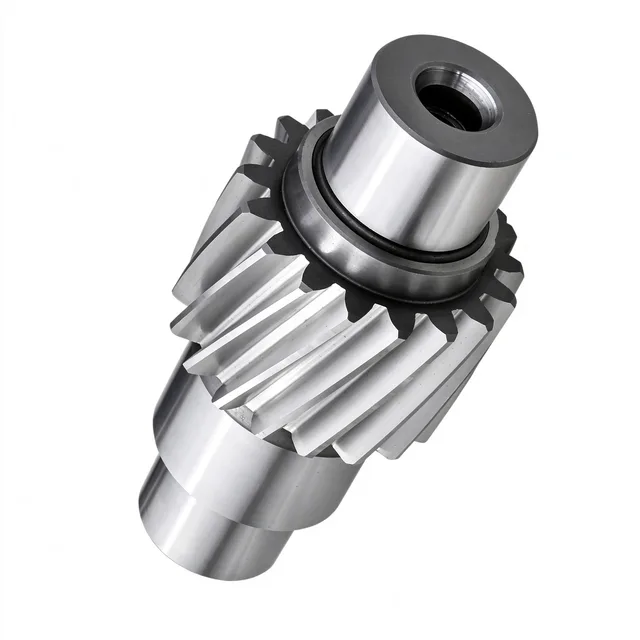
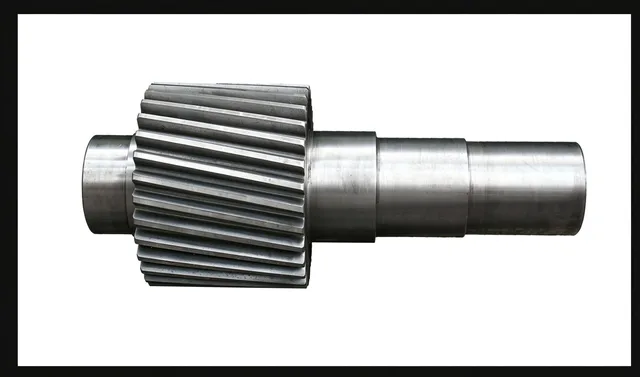
One-piece high-speed input gear shaft combining a helical gear, a stepped bearing journal, and an involute external spline for reducer and industrial gearbox input stages.
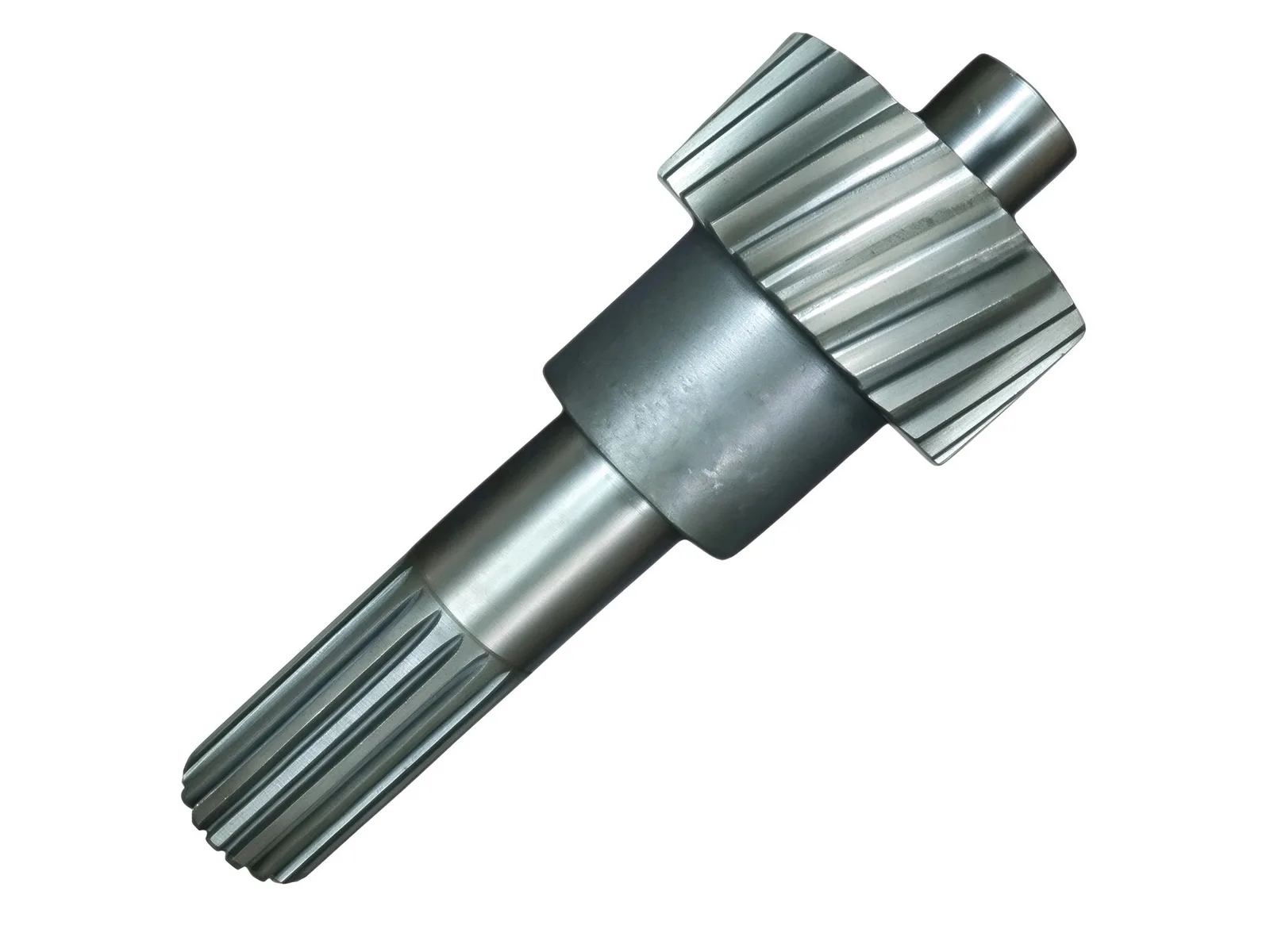
Integral Gear and Shaft Construction
The helical gear teeth are cut into the shaft body itself, so the part runs without an assembled gear-to-shaft joint. This removes fit clearance at the gear seat, keeps the gear and the bearing journals on one centerline, and raises torsional rigidity compared with a keyed or press-fitted gear.
The lower end carries an involute external spline that mates with a coupling or motor output hub, distributing load around the circumference for higher torque capacity than a plain keyed connection. A stepped, enlarged journal between the two ends locates the bearings, spacers, and locknuts and takes the radial and axial locating loads of the shaft.
Machining Capability
Gear teeth are cut and finished in-house for straight, helical, herringbone, and internal tooth forms, with a maximum machinable outside diameter of Ø8 000 mm and modules up to M60. Shaft features including keyways, splines, threads, and end-face flange holes are turned and milled on the same part.
Blanks can be supplied as castings, forgings, or rolled rings, so the process route is matched to the load case and the required grain flow rather than to a single stock form.
Heat Treatment and Quality Control
Common grades are 20CrMnTi and 42CrMo. Gear shafts are carburized and quenched, or quenched and tempered with induction hardening of the tooth flanks, balancing core toughness with surface hardness for high-speed alternating and shock loads.
Inspection covers tooth pitch, runout, and hardness, with ultrasonic testing available on request. Results are recorded per batch so the hardened case, tooth geometry, and journal dimensions can be traced back to the part.
Applications and Customization
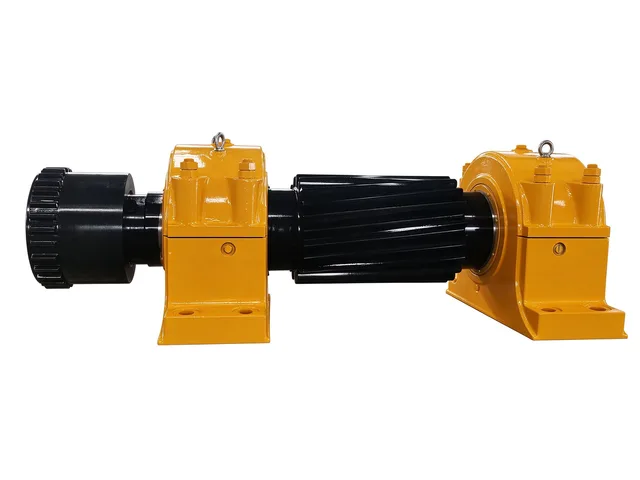
These shafts are commonly used as the high-speed pinion of hardened-tooth helical gear reducers and industrial gearboxes, in the drive trains of conveying machinery, metallurgy and mining equipment, cranes and transport systems, machine tools, and building materials plants, where they mesh with a large helical wheel to provide the first reduction stage.
Sizes, journal fits, spline profiles, tooth geometry, and heat treatment are built to drawing or sample. Tooth profile modification, chamfering, and marking can be included when the application calls for lower noise or specific assembly orientation.
Specifications
- Typical materials
- 20CrMnTi, 42CrMo
- Heat treatment
- Carburizing and quenching; or quenching and tempering plus tooth-surface induction hardening
- Gear type
- Helical cylindrical gear, integral with the shaft
- Input end
- Involute external spline
- Structure
- One-piece gear shaft with stepped bearing journal
Common questions
- Can you machine this part to my drawing?
- Yes. Every part is quoted from the drawing. Send a PDF, DWG, DXF, STEP or IGES file with the material, quantity and any inspection requirements, and we reply within one working day.
- How are the material and heat treatment decided?
- They follow your drawing. The specification table shows the range normally used for this part type; the final material and heat treatment are confirmed with the quotation.
- What lead time and inspection come with the part?
- Lead time is set in the quotation and depends on material, size, quantity and inspection scope. Material verification, in-process checks and final inspection records are archived with the part, and any extra certification is agreed before production.
- How is the part packed for export?
- Export parts are rust-proofed and packed for the transport method and destination confirmed in the quotation, with lifting points and markings agreed before dispatch.
Every part is quoted from the drawing itself, not from a size band. Send it over and we answer with the process, the lead time and the tolerance we can hold.
Quote this part