
Technical articles
SN and SNU split bearing housings: what actually interchanges
Most replacement bearing housings are ordered from a photograph of the failed part and the shaft diameter. That is enough to quote, and not enough to guarantee a fit: a split housing is located by its shaft center height, the bolt spacing of its base and the bore tolerance of the cap.
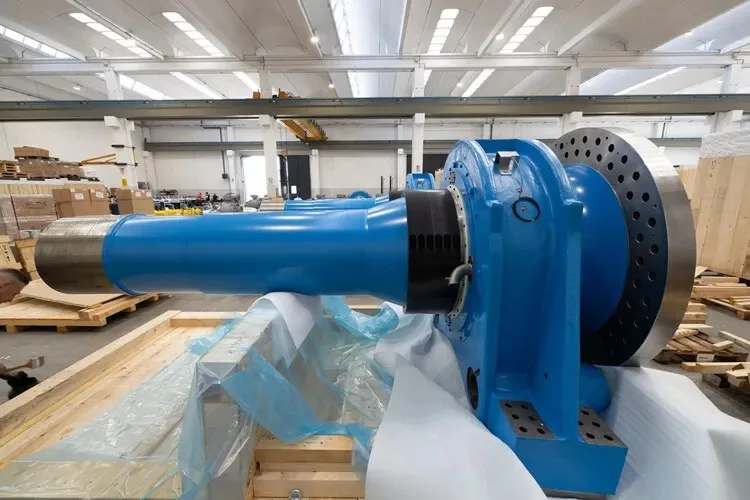
A photograph cannot hold a center height
The photograph shows the shape, the number of bolts and the general proportions. What it cannot show is the shaft center height: there is no datum in the picture to measure from. Nor does it carry the bolt spacing to the tolerance that decides whether the housing drops onto the existing foundation. The bore tolerance is missing too, and that is the difference between a bearing that seats correctly and one that is either too tight or too loose.
The shaft diameter is a useful starting point, but it only fixes the bearing size. Two housings can take the same shaft and still not interchange.
The three dimensions that decide a replacement
If center height, bolt spacing and bore tolerance all agree, an SNU bearing housing can be dropped onto an existing foundation without touching the grout. If only the bore agrees, the base has to be re-drilled, and that is a site job rather than a machining job.
Center height sets the shaft line. Bolt spacing sets the position of the base on the foundation. Bore tolerance sets the fit of the bearing in the cap and base. Once the housing is in place, all three have to be right at the same time, which is why a replacement is quoted from a drawing or a measured sample rather than from a photograph.
What each mismatch means
Get the center height wrong and the shaft line moves. The coupling no longer lines up with the drive, and the bearing carries an alignment load it was not designed for. Bolt spacing wrong means the housing will not sit on the existing holes; drilling new ones is possible, but the grout and the foundation have to be sound enough to take them. The bore is the most direct of the three: the bearing either will not go in or will not stay put.
The order of checks matters. Center height and bolt spacing are measured on the foundation and on the old housing; bore tolerance is measured on the bearing and on the new housing. All three readings are compared before the housing is machined.
Split construction and why it stays the default
The housing is built as two pieces: a base and a cap fastened together with high-strength bolts. The bearing can be assembled, inspected or replaced without pulling the whole transmission shaft out of the machine, which shortens maintenance time and lowers the skill required on site.
The joint faces are machined so the cap seats squarely on the base, keeping the bore round and the two halves aligned after repeated opening and closing during service. That is the part of the design that matters most in a maintenance store: a split housing is opened often, and the joint has to come back to the same position every time.
The one-piece cast base with slotted mounting holes keeps the structure stiff and dampens vibration, while the slots allow small position adjustment to absorb assembly tolerances on site. Housings of this type are normally fitted with spherical roller bearings, so they take large radial loads and a certain axial load while compensating for small shaft misalignment and deflection. This makes them common in heavy-duty, shock-loaded industrial drives.
Split, one-piece or pillow block
A pillow block bearing housing carries the shaft on a raised base and is the simpler choice for a new layout. A split design is the one a maintenance crew can strip without pulling the shaft, which is why it stays the default for conveyors, fans and mill drives.
A one-piece housing is the other answer for a different duty. Because the section is closed and ribbed, it is stiffer than a split housing and suits low-speed, heavy-load and high-impact service, such as rolling mill roll necks, crusher main shaft supports and heavy ball mills. The choice is set by how the machine is maintained, not by which housing looks stronger.
Lubrication and sealing interfaces
Threaded ports on top of the cap are used to add grease or oil for continuous lubrication of the bearing inside. Both ends of the bore can be fitted with seals, end covers or dust covers to block dust and water from entering the housing and to keep lubricant from leaking out.
Seal type, groove dimensions and port positions are machined to the customer's drawing so the housing matches the lubrication and sealing arrangement of the machine it goes into. A replacement that fits the shaft but not the seal groove will leak, and a replacement that fits the base but not the lubrication port cannot be serviced on the same schedule.
Machining and quality control
Bores, joint faces, base pads and mounting holes are machined on CNC boring and milling equipment, with bore diameter, squareness of the joint face and base flatness checked against the drawing before shipment. Castings are poured in-house and bored on the horizontal boring machine.
Bore size, seal configuration, lubrication port threads and base hole pattern can all be customized to a drawing or sample. Typical applications include belt conveyors, fans, water pumps, heavy reducers, mining equipment and metallurgical rolling mills.
Lead time and quantity
A replacement housing is quoted from the drawing or the sample and delivered in 8 to 12 weeks. One piece is enough; there is no pattern or tooling charge. The quote is based on the three locating dimensions, so the fit can be checked against the foundation before the housing is shipped.
These notes describe processes we actually run. If you have a part to quote, send the drawing and we will answer with the process, the lead time and the tolerance we can hold.
Send drawing, get a quote