
Technical articles
Crusher spare parts and conveyor rollers: ordering without a catalog number
Crusher spare parts are usually ordered after the OEM number has stopped existing. The part on the floor is then the only reliable reference, and four dimensions plus a photograph are enough to quote and to machine.
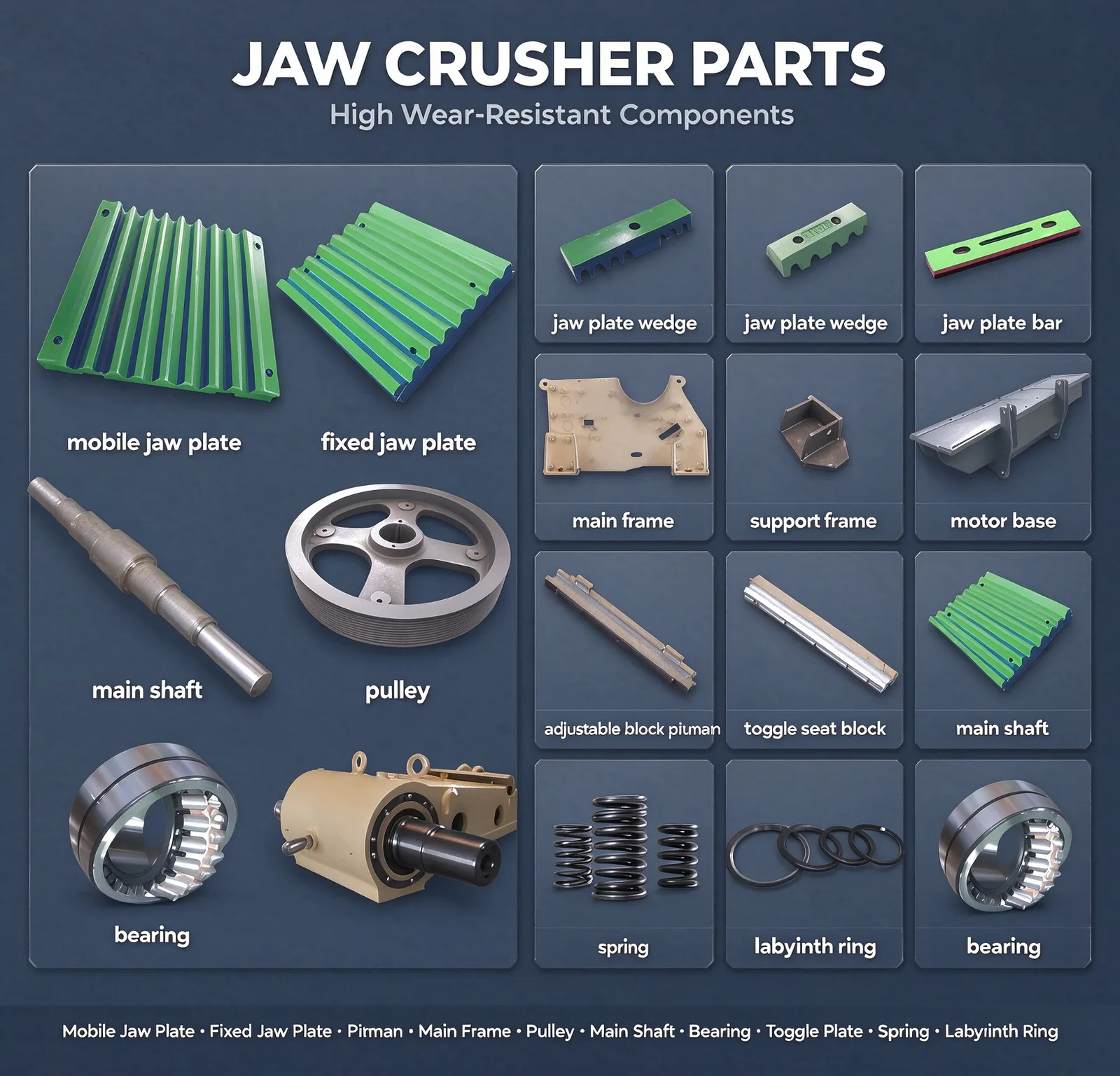
When the number no longer helps
An OEM number is useful while the original supplier still lists the part. Once the machine is out of production, or the part has been superseded twice, the number either returns nothing or returns something that no longer matches. The worn part is then the better reference. It carries every dimension that matters, including the ones the catalog never printed.
The work of ordering is mainly measurement. A photograph alone will not do, because a photograph cannot tell the shop the bearing seat diameter or the bolt circle. A worn part sent to us, or a set of measured dimensions, can.
What to measure on a crusher part
For a shaft or a frame, measure the bearing seat diameters, the overall length, the flange bolt circle and the number of bolts. Those four readings decide whether the part can be machined to fit and whether the existing bearing and coupling will go back on.
For wear parts, measure the profile, the locating faces and the material grade. The profile decides how the part sits against the material flow; the locating faces decide whether it seats correctly; the material grade decides how long it lasts. If the grade is unknown, the part is checked against the mill certificate before the material is specified.
Crusher shafts and frames
A cone crusher main shaft is a single part with a tapered cone body and stepped journals at both ends. The cone face is the mounting datum for the wear mantle, and the journals carry the support bearings and the eccentric drive components. The part is cast as a whole and then finish-machined, with the work planned around the coaxiality of the cone face and the journals.
Alloy cast steel or high-manganese steel is selected according to the working condition, and quenching and tempering are applied to raise strength together with impact toughness. Parts are made to the customer's drawing or to the crusher model: cone angle, cone face dimensions, journal sizes, material grade and heat-treatment indicators are confirmed against the technical documents before production.
Wear parts and tooth roll sleeves
A toothed roll crusher sleeve is a one-piece casting, so the teeth and the body share one continuous structure with no welded joints. Multiple staggered rows of wedge-shaped teeth run around the outside diameter; each tooth presents a narrow leading edge that bites into the feed and a widening body that splits it. Because there is no weld seam or assembled tooth, the sleeve takes the direct impact of large lumps without tooth loss or cracking at the tooth root.
The sleeve is cast in high-manganese steel, high-chrome cast iron or multi-alloy wear-resistant cast steel, then normalized, tempered and water toughened. Under impact load the working face work-hardens in service, so surface hardness rises with running hours. The central bore is machined as a fit surface and mounted on the crusher main shaft by shrink fit or by a keyed connection. When the teeth are worn out the whole sleeve is swapped, which protects the main shaft.
Conveyor idlers
A conveyor idler roller is defined by shell diameter, face length, shaft ends and bearing type. The body is machined from seamless steel tube, with built-in rolling bearings and a sealing assembly at both ends. The shaft ends project so the roller can be fixed to the conveyor frame, and the outer surface is coated for rust protection.
The design is modular, so a worn roller is swapped on site without reworking the frame. Tube ends are machined, bearing housings fitted, the shaft welded or pressed in, and the coating applied, with each step checked against the drawing for that roller size. Once the shell is welded and machined it is balanced and checked for runout, because an unbalanced roller takes the belt edge with it.
The end seal blocks dust, water and spillage from reaching the bearings, which keeps running resistance low. This makes the roller suitable for mining, aggregate, cement, port and grain handling duty where dust and heavy loads are normal. Plain, buffer, anti-static and waterproof versions can be quoted once the working duty is defined.
Measuring a part that has no drawing
A part that is no longer made can be reproduced from the original. We measure the sample and draw it ourselves, so a spare that no longer exists in any catalog can still be machined. The measurements are checked against the mating parts: the bearing that has to fit the seat, the coupling that has to fit the shaft end, and the frame that has to take the base.
A drawing is still faster. If one exists, even an old one with handwritten changes, it gives the tolerances and the material grade in a form that can be checked before machining. Without a drawing, the sample and the mating parts become the drawing.
Quantity, lead time and inspection
One piece is enough for both crusher parts and conveyor rollers, and there is no tooling charge. Delivery is 8 to 12 weeks, and a batch order for a shutdown can be scheduled against the same drawing.
Each batch is checked for body diameter, overall length, shaft extension, radial runout and coating thickness before packing; bearing seats are gauged and the grease fill is recorded. Material verification, dimensional checks and the inspection record travel with the part, and English reports are available for export orders. Parts are packed with rust protection and export packing for the destination.
These notes describe processes we actually run. If you have a part to quote, send the drawing and we will answer with the process, the lead time and the tolerance we can hold.
Send drawing, get a quote