
Technical articles
Mill trunnions and end covers: machining both halves of the joint
In a ball mill the hollow shaft is the ball mill trunnion: it carries the shell load on the trunnion bearings and feeds the mill through its bore. The end cover closes the same joint, so the bolt circle and the spigot have to be cut against the same centerline.
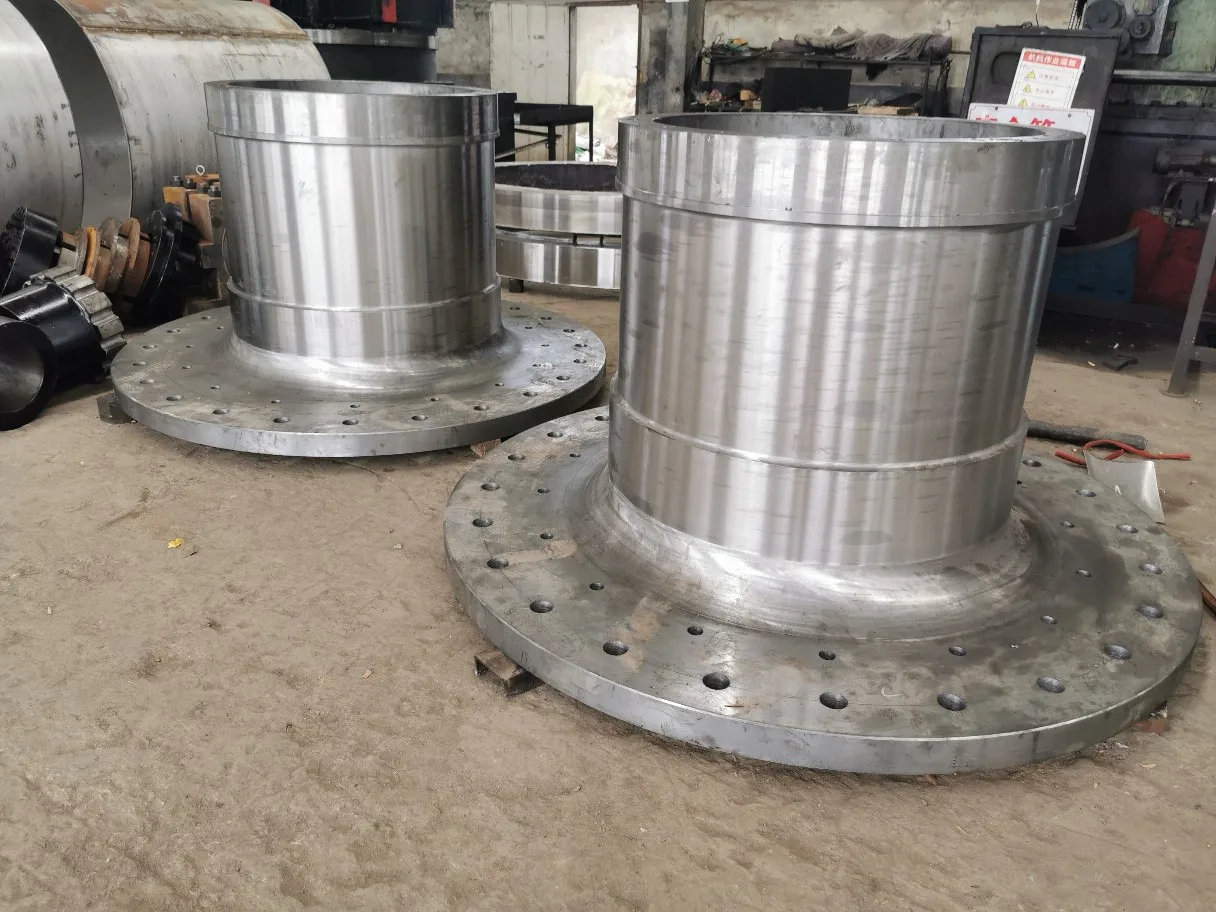
One joint, two parts
The trunnion and the end cover are separate parts, but in service they act as one interface. The end cover is bolted to the mill shell through a large flange, and the trunnion passes through the hollow center of that cover into the bearing. The flange faces, the bolt holes and the trunnion journal are machined after welding, which makes the trunnion the rotation datum and keeps the drum concentric with the main bearings.
When the two parts are machined on the same centerline, the joint closes evenly: the spigot enters its seat, the bolt holes line up, and the flange faces meet over their full area. When they are not, the bolts can still be tightened, which is exactly why the problem is easy to miss at assembly.
What the trunnion carries
The trunnion is the hollow shaft at the end of the mill. It carries the shell load on the trunnion bearings and feeds the mill through its bore. The bore is also the passage for material and air into and out of the grinding chamber, so its straightness matters for the process as well as for the bearing fit.
The shell itself is rolled and welded from heavy steel plate. Steel balls and rods inside the drum are lifted by friction and centrifugal action and fall back onto the charge, grinding material by impact and attrition. The drum takes repeated impact loads in continuous heavy duty, and the trunnion is the point where that load leaves the drum and enters the bearings.
The end cover side of the joint
The end cover is welded from heavy steel plate into a flanged cylindrical pressure structure. A ring of radial stiffener ribs sits around the large top flange to raise joint stiffness and resistance to deformation. In service the top flange is bolted and mated to the mill shell, so the cover and shell together absorb the dynamic and impact loads of grinding.
The center of the cover is hollow and takes the trunnion, the feed spiral or the discharge device. It serves both as the mounting datum for the mill's rotary support and as the passage for material and air. Flange faces, spigots and bolt holes are machined to drawing to hold mating accuracy with the shell. Feed end covers and discharge end covers are both built to the customer's drawing, including the sizes for different shell diameters.
Machining both parts against one centerline
A mill trunnion is machined with the flange face and the journals referenced to the bore centerline in a single setup. The end cover is machined the same way: its flange face, spigot and bolt circle are cut against the center it will share with the trunnion, not against an edge or a rough cast surface.
A single setup removes the re-fixturing error that appears when a part is turned, moved and turned again. For a joint this size, the error does not show up as an out-of-round bore; it shows up as a gap at one side of the flange, or as a spigot that binds before the faces meet.
When the halves come from different shops
When the end cover comes from a different shop, the bolt circle is usually right and the spigot is not, and the joint leaks slurry within a month. The bolt circle is easy to copy from the old part; the spigot is the surface that actually centers the two halves, and it is the one that gets measured last and machined without reference to the trunnion.
The same problem appears when a worn trunnion is replaced but the end cover is kept, or the other way round. The new part is correct to its own drawing, but the pair has never been checked together. Machining both halves against the same centerline is what makes the pair work.
Repairing a worn journal
A worn journal can be built up and re-machined instead of replaced. The decision depends on how much material has to be added and whether the bearing seat is still sound. If the journal is built up, it is machined back to the drawing dimension and checked for roundness before the cover is matched to it.
The end cover is welded from heavy steel plate, so its weld seams are inspected visually and by the non-destructive method agreed in the technical protocol. The flange faces, spigots and connection holes are machined to drawing after welding.
Inspection before shipment
Both parts are measured on the boring mill and reported together: journal diameter and roundness, flange runout, bore straightness. For a complete shell assembly, final assembly, liner fitting and non-destructive testing are carried out with the drum resting on a 150 t self-adjusting welding roller stand. The stand turns the shell slowly, so full-perimeter welding, liner bolting and inspection are done from a fixed working position.
Before shipment the flange joint fit and bolt hole positions are checked, together with trunnion journal dimensions and radial runout; welding and dimensional records are issued with the unit. Flatness of the flange faces and the position of the bolt holes are controlled against the drawing, and gauge or inspection records are available on request.
What to send with an enquiry
Send the drawing if it exists; if not, send the shaft diameter at both journals, the flange diameter, the bolt circle and the number of bolts, plus a photograph of the wear pattern. A worn journal can be built up and re-machined instead of replaced.
Delivery is 8 to 12 weeks for one piece, with no tooling charge. Material grade, plate thickness, welding procedure and inspection level are fixed by the drawing and technical agreement, so the quotation can state exactly which route the pair will take.
These notes describe processes we actually run. If you have a part to quote, send the drawing and we will answer with the process, the lead time and the tolerance we can hold.
Send drawing, get a quote