
Technical articles
HPGR Rolls: Studs, Edges and the Geometry That Decides Throughput
A high-pressure grinding roll does its work in a gap narrower than a finger. Two rolls turn toward each other, one fixed and one floating on hydraulic rams, and the feed is crushed by inter-particle pressure rather than by a single blow. Everything about the machine is built around keeping that gap even: the roll bodies, the bearings, the frame, the hydraulics, the feed chute.
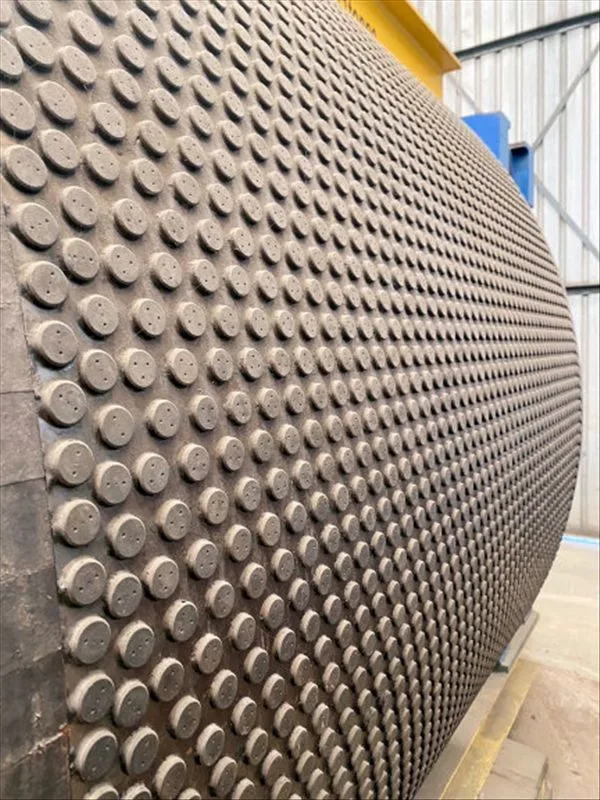
What the surface is doing
A high-pressure grinding roll does its work in a gap narrower than a finger. Two rolls turn toward each other, one fixed and one floating on hydraulic rams, and the feed is crushed by inter-particle pressure rather than by a single blow. Everything about the machine is built around keeping that gap even: the roll bodies, the bearings, the frame, the hydraulics, the feed chute.
The wear part is the roll surface. On most machines that surface is studded, and the studs are what grip the feed. When the studs wear, the machine keeps running and quietly gets worse: throughput falls, the product gets coarser, and the specific energy per tonne climbs. It is one of the few wear failures that costs money before it causes a stoppage.
The stud pattern has two functions. It pulls feed into the gap instead of letting it slip, and it maintains a rough surface that helps the pressure build. A smooth roll on a HPGR is a roller mill with a hydraulic bill.
Stud height and pattern are matched to the duty. Fine, hard feed wears studs by abrasion; coarse feed with tramp metal wears them by impact and breakage. A plant that changes its feed, for instance by adding a pre-crushing stage, will see the stud life change as well, and not always for the better.
The failure modes to watch:
- **Stud flattening** across the whole face. Abrasion, expected, and the wear rate is what you plan around. - **Stud loss in patches**. Usually impact from tramp metal, or a feed distribution problem that is loading one part of the face harder. - **Edge wear**. The edges of the rolls run against the cheek plates, and the gap at the edge decides how much material escapes past the rolls unground. An edge that has worn back is a throughput problem before it is a roll problem. - **Roll body cracking**. Rare, and always worth investigating rather than replacing. Cracks from the bore or from the shaft transition are a design or a load question, not a wear question.
The edge effect, in numbers
Every HPGR has an edge zone where the pressure cannot build. The feed that passes there is not ground, and it is recirculated or it ends up in the product.
The width of that zone depends on the roll diameter, the gap and the edge configuration. Plants that measure it usually do so by sampling the product across the roll width. When the unground fraction at the edges grows, the first suspect is not the studs but the edge sealing and the cheek plate clearance.
This matters for procurement because a roll that is dimensionally correct but has the wrong edge detail will not restore throughput. The edge geometry belongs on the drawing, and a replacement roll measured only for diameter and face width is an incomplete measurement.
Bearings and the floating roll
The fixed roll carries its load straight into the frame. The floating roll moves on rams, and its bearings see a load that changes with the gap, the feed and the hydraulic setting.
Two maintenance signals come from this side of the machine. Bearing temperature on the floating roll that drifts upward at constant load usually means the hydraulic system is compensating for something: a worn bearing, a sticky cylinder, or a gap that is being held wider than the set point. Vibration analysis on the roll shaft, taken at the same load, separates bearing wear from hydraulic behavior.
When the roll is removed, the bearing seats on the shaft should be measured, not just the bearings replaced. A seat that has fretted will take a new bearing out quickly, and the fix at that point is shaft work rather than bearing work.
Measuring a roll for replacement
The useful measurement set for a replacement roll is broader than the obvious three dimensions.
- Roll body outside diameter, measured in several planes along the face - Face width, and the position of the stud field relative to each end - Bore dimensions and the keyway or shrink fit arrangement - Shaft dimensions at the bearing seats, with the datum named - The edge profile, including any relief or chamfer at the ends - Stud pattern: pitch, row offset and stud geometry - Balance requirements from the original drawing, if stated
The last two are the ones most often missing from a worn-part measurement. A roll can be turned to the right diameter and still run badly because the stud pattern is not the original, or because the part was never balanced to the standard the machine expects.
Where the original drawing exists, use it and check the worn part against it. Where it does not, the measurement has to capture the features that the drawing would have carried.
Machining, and what it can and cannot fix
A roll body can be machined: faces turned, bores bored, edges recut, and the shaft journals restored. What machining cannot do is put studs back on a worn face in the original pattern unless the studs are replaced as part of the work. A roll with flattened studs that is only turned will run smoother and grip worse.
That is why the decision on a worn roll comes down to two questions: how much stud height is left, and what is the cost of running a machine at reduced throughput while a replacement is made. Plants with a spare roll set usually run the worn set until the spare is ready. Plants without one tend to replace earlier than the wear data says they need to.
What to send, and what to expect
For a roll inquiry: machine make and model, roll position (fixed or floating), a drawing if one exists, the worn roll if it does not, the stud pattern and any record of the last measurement, quantity, and the shutdown window.
A roll is not a single part in practice: body, shaft, studs and balancing each carry their own lead time, and the quotation names which of them are inside our scope and which are not. A replacement body from an approved drawing runs 8–12 weeks on its own; the studs and the balancing add to that date rather than sitting inside it.
Measuring stud wear
Stud wear is measured in height and in pattern, and both readings belong in the record.
Height is taken at several points across the face, on the same studs at each survey so the numbers compare. A single average across the face hides the pattern: a roll that is worn at one side and full height at the other is telling you the feed is not distributing evenly, and averaging that reading removes the evidence.
Pattern is recorded as a map rather than a number. Photograph the face with a straight edge across it and keep the image with the measurement. Two years later, the photograph shows whether the wear was even or local, which the numbers alone cannot.
The wear rate is what plans the replacement. A roll that loses a measurable amount of stud height per thousand operating hours gives a date at which the remaining height no longer grips. That date should be compared with the lead time for a replacement body, and the comparison is usually what decides whether the spare set is ordered this year or next.
Feed preparation and circulating load
A HPGR is sensitive to what it is fed, more than a ball mill is. Two things in the feed change roll life and throughput together.
The first is the top size. Feed that is coarser than the machine was set for produces impact on the studs rather than compression between particles, and the stud loss appears in patches. The second is moisture. Wet, sticky feed bridges in the feed chute and starves part of the roll face, which then wears unevenly because the loaded area is smaller.
Both show up as a circulating load that climbs without a change in the gap setting. Plants that track the recirculating load against the gap and the feed rate can see a feed problem before it becomes a roll problem.
When to replace the pair
The two rolls work as a pair. Replacing one roll against a worn partner means the new surface takes more of the work, and the edge geometry no longer matches on both sides.
Where both rolls are near the end of their stud height, they are replaced together. Where one has failed early, the decision is whether the other has enough life left to run alongside a new roll without wearing it unevenly. That question is answered by the wear record, not by looking at the face.
The bearings and the hydraulic side of the machine usually outlive one roll set and not two. A plan that replaces the roll set without checking the bearing seats and the ram condition will find the second set wearing faster than the first.
Where the machine is old and the roll is the only record of its own geometry, we measure the worn part and issue a drawing for approval before machining. One piece is enough for that, and there is no pattern charge.
These notes describe processes we actually run. If you have a part to quote, send the drawing and we will answer with the process, the lead time and the tolerance we can hold.
Send drawing, get a quote